8 Bit Serial To Parallel Converter Verilog Code

1 2 3 4 5 6 7 8 9 10 11 12 13 14 15 16 17 18 19 20 21 module piso1 (sout,sin,clk ); output sout; input [ 3: 0 ]sin; input clk; wire [ 3: 0 ]q; inv u1 (p,sl ); and1 u2 (n,sin [ 1 ],p ); and1 u3 (r,sl,q [ 0 ] ); or1 u4 (s,n,r ); and1 u5 (t,sin [ 2 ],p ); and1 u6 (u,sl,q [ 1 ] ); or1 u7 (v,u,t ); and1 u8 (w,sin [ 3 ],p ); and1 u9 (y,sl,q [ 2 ] ); or1 u10 (z,w,y ); dff1 u11 (q [ 0 ],sin [ 0 ],clk ); dff1 u12 (q [ 1 ],s,clk ); dff1 u13 (q [ 2 ],v,clk ); dff1 u14 (q [ 3 ],z,clk ); assign sout = q [ 3 ]; endmodule. Muljtivarka leran instrukciya po primeneniyu.
There is no pin for synchronization. The RS-232 serial protocol has a start and stop bit, logic 0 and 1 respectively. An idle channel will have a logic 1. So if the channel goes from idle to active, 0 will be the first thing you see. If you pick up the channel in the middle of transmission you'll end up having to find the pattern of 10 repeating every 10 bits (8-bit data).
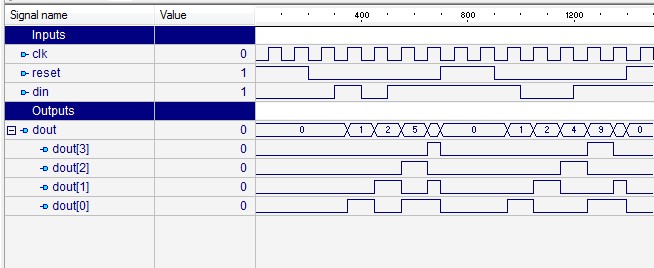
I'm a beginner using verilog. I am trying to make a simple parallel to serial converter (8 bits parallel down to 1 bit serial). I have 2 textbooks but I think it is way too complicated for me to understand. Right now when I try to simulate my simple Parallel-to-Serial module the input of 8-bits parallel appear but only 1 of the 8 serial bit appear.
I actually don't think anyone does that type of synchronization. From observation of devices that used RS-232 to receive data, I always remember seeing garbage if you hooked it up in the middle of a burst of data.
I think most devices need a pause before achieving synchornization.